Tuesday, September 9, 2014

Dreaming and Doing your dream


"There are those who work all day. Those who dream all day. And those who spend an hour dreaming before setting to work to fulfill those dreams. Go into the third category because there's virtually no competition." 

~ Steven J Ross.

Why many famous entrepreneurs struggled with their early formal education?


Q: I am an architect and a young entrepreneur. It’s fairly obvious that most of the world’s great entrepreneurs had issues with their early education. Why is this the case? -- Akosu Paul
This is a very good question, and one that I am often asked by students around the world as they weigh continuing their studies against starting up their own ventures and diving into the world of business. In addition, many also want to know how I was able to start my own career while I was a young student struggling with my schoolwork, and how I eventually got people to take me seriously as an entrepreneur.
Looking back, I believe that the qualities that make for a great entrepreneur -- such as boundless energy, a curious nature and, sometimes, an obstinate streak -- are not often attributes demonstrated by top students in the classroom. So it should not be very surprising that many of the world’s great entrepreneurs and business leaders had difficulties with formal education.
Often, their frustration in the classroom was a result of impatience: The greats were eager to get out and build their businesses, which pushed them to drop out of high school or forgo college in order to follow their dreams. For instance, Walt Disney famously dropped out of school at age 16 to found his animation company, while the great American tycoons of the late 19th century -- Andrew Carnegie, Cornelius Vanderbilt and Thomas Edison -- had little or no formal education before they set out to seek their fortunes. Some entrepreneurs, including Carnegie and Henry Ford, the 20th century industrialist, came from impoverished backgrounds and did not have the support at home to start -- let alone complete -- their formal educations. Rather, they set up businesses to make ends meet and eventually flourished.
More recently, the retail entrepreneurs Philip Green and John Caudwell made their fortunes in the U.K. after leaving high school and building businesses at young ages. And in the tech industry, Steve Jobs of Apple, Michael Dell, the founder of Dell Inc., and Oracle’s Larry Ellison all dropped out of college to create their companies, and they all reaped the rewards of getting an early start.
One thing that entrepreneurs have in common is a talent for seeing things differently. This allows them to identify important gaps in markets or the need for new sectors to serve specific customer demands. But this ability often leads budding entrepreneurs to rebel against the conformity that is common in traditional education.
I was no exception, and I have written in previous columns that I was not great at school. I constantly pushed against rules and authority, and I liked to challenge the way that things were “always” done. My curiosity often got me into trouble with teachers.
But it was not just my attitude that was different -- I had dyslexia. When I was a young student, this learning disability was poorly researched and was often mistaken for laziness or a poor ability to learn. At school I was thought to be slow, and indeed I struggled to keep up. I initially channeled my youthful energy into sport, then after an injury, I got into early business ventures, which failed to take off.
But my learning disability has never been a setback -- it actually gave me a great advantage in business, since I have been able to bring a different perspective to problems and challenges, which often enables me to see solutions more clearly. For example, I have always hated jargon, and I am confused by long and wordy drafts of plans. So in Virgin’s early days, I would ask simple questions that others did not. Over the years, asking the simple questions and striving to answer them have become some of Virgin’s most important characteristics.
When I was a young student, my restlessness and curiosity prompted me to set up Student magazine when I was just 15. Running the magazine actually served as an entrepreneurial education - I learned to effectively build a team, sell advertising, create content and market a product. I was my own boss and never needed to ask permission to try new things, and if I got things wrong, I did not have to fear the wrath of a superior. After all, a willingness to try new things and fail is important to becoming an entrepreneur, yet making mistakes flies against the expectations of traditional schooling.
So in many ways, my education has been my career. For almost 50 years, Virgin’s varied collection of businesses and nonprofits means that I have studied and come to understand many sectors - aviation, banking, media, hospitality and the fitness industry, to name a few. More recently, my career has also given me interesting new perspectives on many significant issues such as climate change, conflict resolution and global health care.
In the end, solutions to big problems such as these won’t come from doing school reports, but by getting out there, asking questions, seeing things differently and finding the answers ourselves.

 Source: Richard Branson
Thursday, September 4, 2014

Success and Poverty

Success and poverty are not respecter of  profession,nationality and family name.They are respecter of principles of responsibilities and creating value for others.
So dream big to a success by being responsible and create value to the entire world!

Tuesday, August 26, 2014

MENTAL GROWTH: A RESEARCH ON HOW A BRAIN IS LIKE A MUSCLE

My 5-year-­old son has just started reading. Every night, we lie on his bed and he reads a short book to me. Inevitably, he’ll hit a word that he has trouble with: last night the word was “gratefully.” He eventually got it after a fairly painful minute. He then said, “Dad, aren’t you glad how I struggled with that word? I think I could feel my brain growing.” I smiled: my son was now verbalizing the tell­-tale signs of a “growth­ mindset.” But this wasn’t by accident. Recently, I put into practice research I had been reading about for the past few years: I decided to praise my son not when he succeeded at things he was already good at, but when he persevered with things that he found difficult. I stressed to him that by struggling, your brain grows. Between the deep body of research on the field of learning mindsets and this personal experience with my son, I am more convinced than ever that mindsets toward learning could matter more than anything else we teach.
Researchers have known for some time that the brain is like a muscle; that the more you use it, the more it grows. They’ve found that neural connections form and deepen most when we make mistakes doing difficult tasks rather than repeatedly having success with easy ones. What this means is that our intelligence is not fixed, and the best way that we can grow our intelligence is to embrace tasks where we might struggle and fail.
However, not everyone realizes this. Dr. Carol Dweck of Stanford University has been studying people’s mindsets towards learning for decades. She has found that most people adhere to one of two mindsets: fixed or growth. Fixed mindsets mistakenly believe that people are either smart or not, that intelligence is fixed by genes. People with growth mindsets correctly believe that capability and intelligence can be grown through effort, struggle and failure. Dweck found that those with a fixed mindset tended to focus their effort on tasks where they had a high likelihood of success and avoided tasks where they may have had to struggle, which limited their learning. People with a growth mindset, however, embraced challenges, and understood that tenacity and effort could change their learning outcomes. As you can imagine, this correlated with the latter group more actively pushing themselves and growing intellectually.
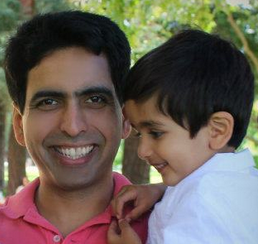
Sal and his son
The good news is that mindsets can be taught; they’re malleable. What’s really fascinating is that Dweck and others have developed techniques that they call “growth mindset interventions,” which have shown that even small changes in communication or seemingly innocuous comments can have fairly long­-lasting implications for a person’s mindset. For instance, praising someone’s process (“I really like how you struggled with that problem”) versus praising an innate trait or talent (“You’re so clever!”) is one way to reinforce a growth ­mindset with someone. Process­ praise acknowledges the effort; talent­ praise reinforces the notion that one only succeeds (or doesn’t) based on a fixed trait. And we’ve seen this on Khan Academy as well: students are spending more time learning on Khan Academy after being exposed to messages that praise their tenacity and grit and that underscore that the brain is like a muscle.
The Internet is a dream for someone with a growth mindset. Between Khan Academy, MOOCs, and others, there is unprecedented access to endless content to help you grow your mind. However, society isn’t going to fully take advantage of this without growth mindsets being more prevalent. So what if we actively tried to change that? What if we began using whatever means are at our disposal to start performing growth mindset interventions on everyone we cared about? This is much bigger than Khan Academy or algebra — it applies to how you communicate with your children, how you manage your team at work, how you learn a new language or instrument. If society as a whole begins to embrace the struggle of learning, there is no end to what that could mean for global human potential.
And now here’s a surprise for you. By reading this article itself, you’ve just undergone the first half of a growth­-mindset intervention. The research shows that just being exposed to the research itself (­­for example, knowing that the brain grows most by getting questions wrong, not right­­) can begin to change a person’s mindset. The second half of the intervention is for you to communicate the research with others. We’ve made a video (above) that celebrates the struggle of learning that will help you do this. After all, when my son, or for that matter, anyone else asks me about learning, I only want them to know one thing. As long as they embrace struggle and mistakes, they can learn anything.

Thursday, August 14, 2014

Business is all about Relationship

It is easy to forget that people do business with people they like.This implies that business is all about relationship.
This implies successful business are those which are prone to make friendship and networking.Thus,relationship involves among others,shaking hands,do lunches,spread your good will,trying whatever you do to touch people's hearts and evangelizing your message


Quotation from Jay-Z

 "I am not a businessman.I am a business, man"